 English
 简体中文
简体中文
Views: 0 Author: Site Editor Publish Time: 2026-07-15 Origin: Site


In highly corrosive fluid environments, pump failure exceeds a simple maintenance issue. It creates immense environmental, safety, and production-halting liabilities. Plant managers face intense pressure to maintain continuous operations safely under hazardous conditions. Today, plant engineers and procurement teams struggle to balance upfront capital expenditure against long-term operational reliability. Choosing substandard equipment often leads to rapid degradation, dangerous leaks, and catastrophic system failures. Facilities desperately need a verifiable approach to ensure consistent, safe performance. Adhering to the ISO standard—specifically ISO 2858 and ISO 5199—alongside Titanium (TI) wet-end materials offers a predictable baseline for heavy-duty chemical processing. You will discover how this strict standardization reduces inventory risks and ensures global compatibility. We will explore mechanical criteria, material justifications, and strategies for vetting reliable manufacturers to optimize your next procurement cycle.
Standardization: ISO-compliant chemical pumps ensure global dimensional interchangeability, reducing reliance on single-source proprietary parts.
Material Justification: Titanium (TI) drastically lowers lifecycle costs in highly aggressive applications (e.g., chlorides, hypochlorites) where standard stainless alloys fail prematurely.
Evaluation Focus: Procurement should weigh hydraulic efficiency, mechanical seal configurations, and back-pull-out designs over initial unit cost.
Sourcing Strategy: Direct engagement with an OEM chemical pump manufacturer provides necessary material certification and application-specific performance testing.
Plants operating globally face a major business problem. They expand facilities and often mix pump standards across regions. This mixes ANSI and ISO platforms across different production sites. It creates massive inventory bloat immediately. Maintenance teams face inconsistent repair protocols. Managing spare parts becomes a logistical nightmare. You end up storing duplicate parts for identical applications. This wastes valuable capital and warehouse space.
Modern industrial chemical handling demands strict operating ranges. The ISO 2858 and ISO 5199 standards deliver this necessary predictability. They set rigid parameters for vibration limits. They mandate specific baseplate dimensions and flange locations. European facilities heavily prefer ISO standards for these reasons. Increasingly, global plants adopt ISO over ANSI (ASME B73.1). They need standardized platforms for heavy-duty applications. A unified standard simplifies global procurement strategies significantly. It allows engineers to design piping layouts with absolute certainty.
People often assume dimensional standards guarantee "plug-and-play" simplicity. This represents a dangerous common misconception. Casing dimensions do match across different brands. However, internal hydraulics vary wildly by manufacturer. Seal chambers also differ widely. You cannot blindly swap internal components between brands. You must verify internal clearances manually. Always check mechanical seal housing dimensions before ordering replacements. True interchangeability applies primarily to the external piping envelope.
Common Mistakes in Standardization:
Assuming an ISO 2858 pump automatically meets ISO 5199 mechanical requirements.
Ignoring motor frame differences between IEC and NEMA standards during swaps.
Failing to verify baseplate grouting compatibility for new pump installations.
Standard Comparison: Dimensional and Mechanical Features
Feature Category | ISO 2858 / 5199 | ANSI B73.1 |
|---|---|---|
Dimensional Focus | Metric units, universal external envelope. | Imperial units, primarily North American usage. |
Mechanical Rigidity | Strict limits on shaft deflection and vibration. | Varies by specific manufacturer design. |
Flange Ratings | Typically DIN/EN standards (PN16, PN25). | ASME B16.5 standards (Class 150, 300). |
Global Adoption | High preference in Europe, Asia, and Middle East. | Dominant mostly in the United States and Canada. |
Standard alloys fail frequently in severe chemical environments. Materials like 316SS or Duplex stainless steel suffer rapid degradation. They experience severe pitting in specific halogens. Crevice corrosion destroys them rapidly in hot acidic environments. Stress cracking ruins standard impellers without warning. You face sudden, catastrophic production failures. These failures dump hazardous chemicals into your facility. They trigger massive environmental fines and safety audits.
Titanium offers a massive operational advantage here. Grade 2 and Grade 7 Titanium provide exceptional chemical resistance. They easily handle wet chlorine gas safely. They resist aggressive seawater environments perfectly. They withstand boiling nitric acid without degrading. You must evaluate the upfront premium of a TI process pump carefully. Compare this initial cost against planned downtime expenses. Calculate the labor expense of quarterly alloy replacements. Lower-grade materials force constant maintenance interventions. Upgrading to titanium saves substantial money over time. It guarantees continuous production in hostile environments.
Sourcing titanium carries specific material risks. You must verify material purity strictly. Cheap castings often hide dangerous porosity issues. Pores inside the metal cause sudden structural failure under pressure. Always audit your suppliers thoroughly before purchasing. Demand strict casting quality controls.
Best Practices for Material Selection:
Analyze your exact fluid composition, including trace chlorides and operating temperatures.
Consult a metallurgist to choose between Titanium Grade 2 and Grade 7.
Request dye penetrant testing on all cast titanium impellers.
Verify compatibility of the titanium casing with your connected piping materials.
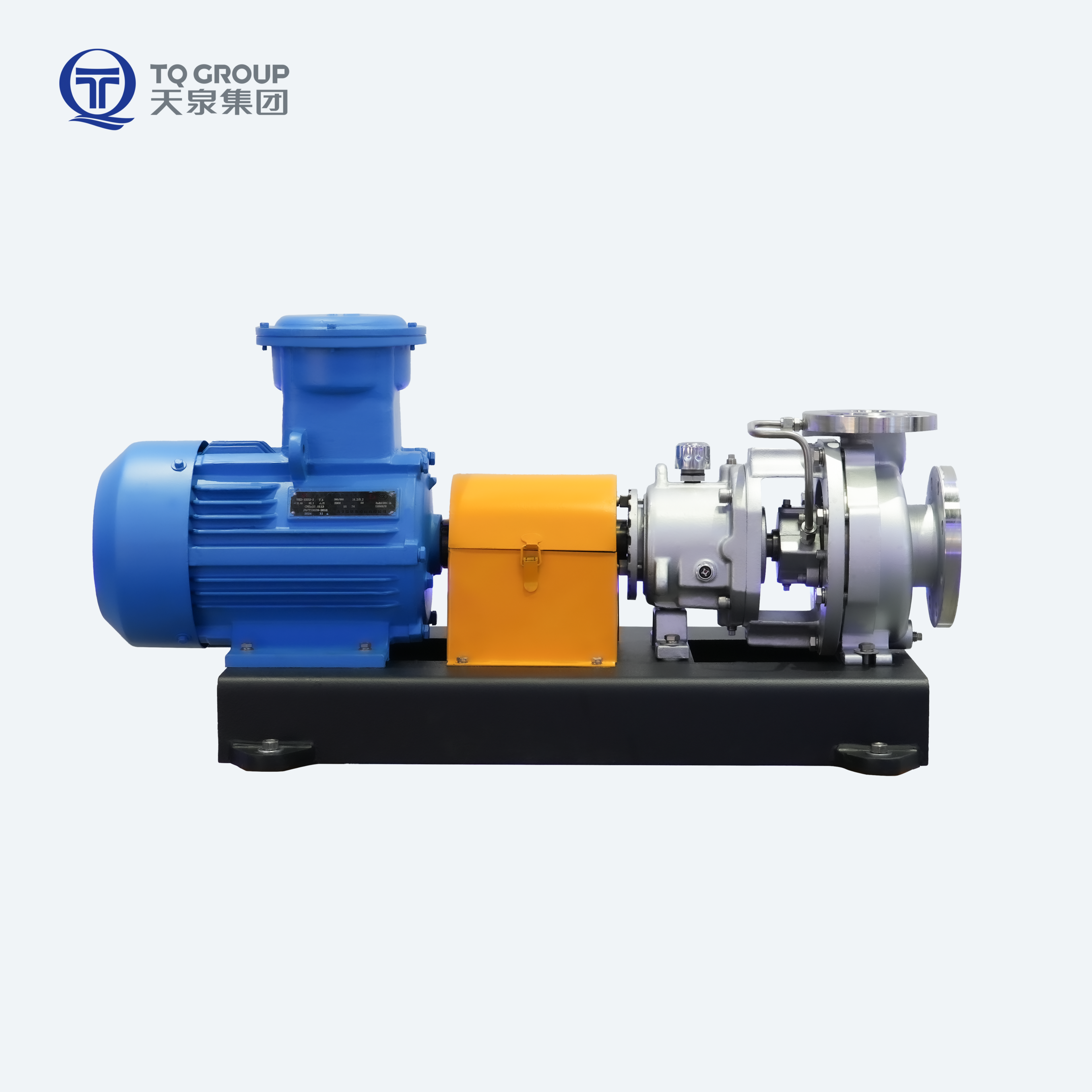
Shaft sealing represents the primary failure point. Hazardous applications demand flawless emission control. You must evaluate single versus double mechanical seals carefully. Double seals offer superior environmental protection. They require specific API piping plans for constant lubrication. API Plan 53A provides pressurized barrier fluid safely. Magnetic drive alternatives offer true zero-leakage performance. They eliminate the mechanical seal entirely. They use magnetic fields to rotate the internal impeller. This completely isolates the hazardous fluid from the atmosphere.
Maintenance teams require specific uptime features. The "back pull-out" design is absolutely essential. It allows technicians to remove the entire rotor assembly easily. They do this without disconnecting external pipework. They leave the motor completely bolted down. This feature drastically cuts repair hours. It reduces pipe strain risks during reassembly. An ISO chemical pump mandates this specific design feature. It prioritizes fast, safe maintenance interventions.
Hydraulic tolerances require precise technical evaluation. You must calculate Net Positive Suction Head (NPSH) requirements. A poorly selected pump will cavitate quickly. Cavitation implosions destroy the titanium impeller rapidly. Material strength cannot stop severe cavitation damage. You must ensure adequate suction pressure always. Compare your available suction head (NPSHa) against the required head (NPSHr). Always maintain a safety margin of at least one meter.
Seal Configuration Matrix
Seal Type | Leakage Risk | Maintenance Complexity | Ideal Application |
|---|---|---|---|
Single Mechanical Seal | Moderate | Low | Non-hazardous, cooling water, mild acids. |
Double Mechanical Seal | Low | High (Requires barrier fluid system) | Toxic fluids, concentrated acids, strict emission zones. |
Magnetic Drive (Sealless) | Zero | Moderate (Requires clean fluids) | Lethal chemicals, highly volatile solvents. |
You must choose your supply partner carefully. Integrators and distributors offer wide catalogs. However, direct Original Equipment Manufacturers provide deeper expertise. A direct OEM chemical pump manufacturer controls the engineering. They control the complex titanium casting process directly. They understand the specific metallurgical challenges involved. Distributors often lack this deep technical knowledge. Direct communication prevents costly specification errors.
Compliance scrutiny protects your facility from inferior products. You must require traceable material test reports (MTRs). These reports verify all titanium components accurately. Demand documented performance curves matching ISO 9906 grades. Require successful hydrostatic testing results clearly. Do this prior to any equipment shipment. Hydrostatic tests confirm casing integrity under high pressure. They prove the pump will not rupture during operation.
Assess the supply chain stability rigorously. Evaluate lead times for raw titanium castings. Titanium takes much longer to source than iron. Standardizing on common ISO dimensions helps mitigate this slightly. Evaluate the availability of spare parts kits locally. Ensure they offer robust local technical support. You need expert help during post-installation commissioning. A good manufacturer provides field engineers for startup assistance.
How to Audit a Manufacturer:
Request their ISO 9001 quality management certificates.
Ask for case studies involving titanium pumps in similar chemical applications.
Verify their in-house testing facility capabilities (e.g., flow, head, NPSH testing).
Check their warranty policies regarding corrosion and mechanical failures.
Installation errors destroy premium equipment quickly. Baseplate grouting requires absolute precision. You must use high-quality epoxy grout for chemical resistance. Pipe strain on pump flanges ruins alignment immediately. It destroys bearings and mechanical seals prematurely. Precise laser alignment is mandatory before startup. Failure here negates all material benefits of titanium. You must train your installation contractors properly. They must follow strict ISO installation guidelines.
You must calculate long-term financial impacts accurately. Initial purchase price misleads buyers frequently. It typically represents under fifteen percent of total expenses. This covers the ten-year lifespan of a chemical process pump. You must factor in daily energy consumption. Hydraulic efficiency saves massive electrical costs over time. Factor in routine seal maintenance schedules. Include the massive financial value of avoided downtime. Premium equipment prevents expensive midnight emergency repairs.
Use a logical shortlisting process for procurement. Move to pilot testing initially. Test a single titanium unit first. Place it in the most corrosive application in your plant. Monitor its vibration and performance closely for six months. Prove its reliability before attempting a plant-wide rollout. This empirical data justifies the larger capital expenditure clearly. It removes the guesswork from engineering decisions.
Key Metrics for Lifecycle Tracking:
Mean Time Between Failures (MTBF) for mechanical seals.
Annual energy consumption based on motor efficiency and hydraulic design.
Cost of replacement wear parts over a five-year period.
Lost revenue attributed to unscheduled pump downtime.
The strict engineering tolerances of ISO 5199 provide unmatched mechanical stability. The metallurgical resilience of Titanium prevents rapid chemical degradation. Combining these elements creates a highly defensible procurement choice. It serves severe applications perfectly and predictable. Plant engineers gain peace of mind knowing the equipment will endure harsh conditions. Procurement teams secure long-term value through drastically reduced repair cycles.
Take clear, decisive steps next. First, conduct a comprehensive fluid compatibility audit across your facility. Second, request specific lifecycle cost projections. Ask your shortlisted OEMs for these detailed financial models. Base them entirely on your actual site conditions. Finally, establish a pilot testing phase immediately to prove performance in the real world.
A: They are different but complementary standards. ISO 2858 covers external dimensions and nominal duty points. It ensures physical interchangeability between different brands. ISO 5199 dictates strict technical and mechanical requirements. It covers vibration limits, bearing life, and seal chamber designs. You need both for a reliable pump.
A: Specialized titanium castings require extended processing. Lead times typically range from 12 to 20 weeks. This takes much longer than standard cast iron or stainless steel. Material sourcing, specialized pouring processes, and strict quality control cause these delays.
A: Direct replacement is impossible without modifications. Baseplate dimensions differ significantly between the two standards. Piping elevations do not match natively. Flange standards vary greatly between DIN and ASME. You will require extensive pipework and foundation modifications to swap them.
A: You must demand strict documentation from the supplier. Require EN 10204 3.1 material certificates for your order. These must cover all wetted metallic components. This standard guarantees traceability back to the original titanium melt. It proves the metallurgical integrity of your equipment.


