 English
 简体中文
简体中文
Views: 0 Author: Site Editor Publish Time: 2026-07-08 Origin: Site


In mission-critical facilities, electric grid failures during a fire event pose severe threats to life and property. Relying solely on municipal power introduces an unacceptable risk when building electrical systems become compromised. You need a highly dependable, independent mechanical power source to drive suppression systems effectively. A diesel-powered solution bridges this critical gap perfectly. When configured correctly, these units deliver autonomous, reliable performance without demanding a massive spatial footprint. This guide provides facility managers, MEP engineers, and procurement officers with an evidence-based framework. We will help you evaluate, size, and source these vital systems for commercial and industrial applications. You will discover exactly how to balance spatial efficiency, hydraulic demands, and strict regulatory compliance requirements seamlessly. By understanding these engineering fundamentals, you protect your assets and ensure absolute readiness.
Design Efficiency: End suction configurations minimize footprint and simplify piping layouts for low-to-medium flow requirements.
Grid Independence: Diesel-driven systems ensure uninterrupted fire suppression regardless of facility power loss or electrical infrastructure damage.
Compliance is Non-Negotiable: Viable units must meet strict UL/FM approvals and function strictly as an NFPA20 fire pump.
Facilities must carefully balance required flow rates (GPM) and pressure (PSI) against available mechanical room space. Budget constraints also dictate system selection heavily. Engineers face a complex puzzle during the design phase. You must choose a pump configuration capable of handling worst-case fire scenarios without compromising structural layouts. The core engineering problem involves maximizing hydraulic output while minimizing physical space.
How does an end suction fire pump compare to a horizontal split-case alternative? Let us examine the technical differences.
Capacity limits: End suction units typically maximize their efficiency around 1,500 GPM. Massive industrial flow demands usually dictate split-case selections. However, for most commercial buildings, the end suction capacity provides more than enough suppression power.
Footprint: The single-suction, overhung impeller design demands significantly less floor space. It helps you optimize tight mechanical rooms. This design eliminates the bulky dual-bearing housing found in split-case models.
Piping geometry: Fluid enters the end and discharges perpendicularly at the top. This geometry simplifies discharge header routing efficiently. You avoid complex pipe bends, which ultimately reduces friction loss in your system.
Electrical backups like standby generators often prove less reliable or more complicated to integrate. A dedicated mechanical diesel drive guarantees pure autonomy. We know electrical grids fail during major structural fires due to heat damage on conduits. Diesel engines ensure constant hydraulic pressure even if your entire building loses power completely. They operate independently of transfer switches and electrical distribution panels.
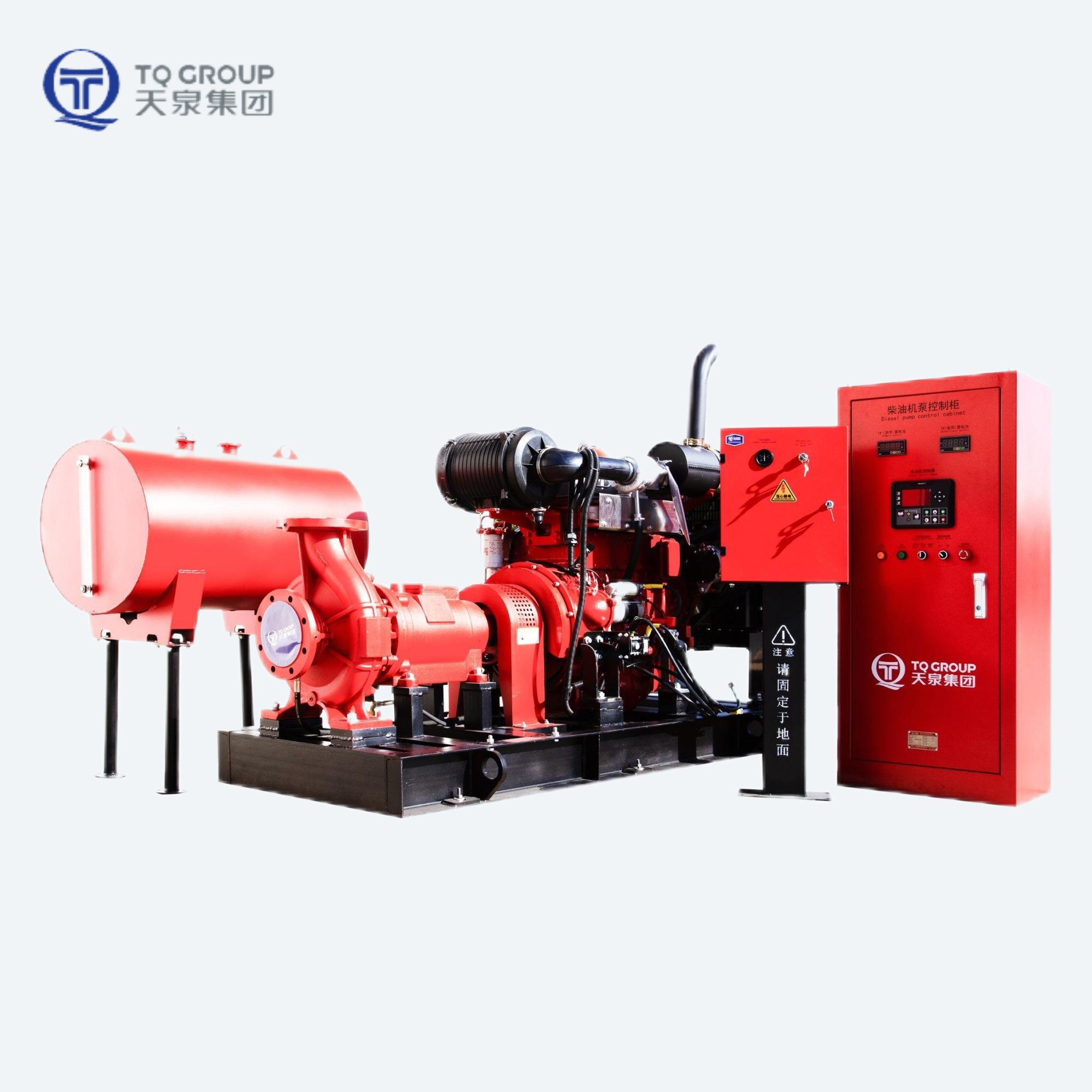
You must evaluate the pump performance curve strictly against fire protection codes. The selected unit must provide 100% of its rated capacity at the rated pressure. Furthermore, it must deliver 150% rated capacity at no less than 65% of rated pressure. This curve ensures the system can handle multiple open sprinkler heads simultaneously.
You also need to calculate the Net Positive Suction Head required (NPSHr) meticulously. Proper NPSHr calculations prevent destructive cavitation inside the casing. Cavitation occurs when water vaporizes due to low pressure, forming bubbles that collapse violently against the impeller. A well-designed horizontal diesel fire pump minimizes this required head to ensure smooth, destructive-free operation.
Casing requirements demand incredibly robust materials. Ductile iron or cast iron work best for these applications. They easily withstand maximum hydrostatic pressures during churn (zero flow) conditions. Ductile iron offers superior tensile strength, making it highly resistant to sudden pressure spikes.
Impeller materials require equally careful selection. Bronze or stainless steel resist corrosion beautifully. They maintain perfect dynamic balance over decades of standby status. Because these pumps sit idle for long periods, inferior materials would rust and seize, causing catastrophic failure during an emergency.
Your mechanical drive demands a robust, direct-injection diesel engine. Direct injection provides rapid starting capabilities and consistent torque delivery. Cooling systems present another critical design choice for mechanical engineers.
Heat exchangers utilize the pump's own water supply to cool the engine block. They serve as the standard choice for enclosed mechanical rooms. Radiators blow hot air into the room, severely complicating ventilation requirements. We strongly recommend heat exchangers for most indoor setups to maintain ambient room temperatures.
Cooling System Type | Mechanism | Room Ventilation Needs | Best Application |
|---|---|---|---|
Heat Exchanger | Uses pump discharge water to cool engine coolant | Minimal (only combustion air needed) | Enclosed mechanical rooms |
Radiator | Uses a fan to blow ambient air across cooling fins | High (requires large exhaust louvers) | Outdoor enclosures or highly ventilated spaces |
Utilizing non-UL-listed or non-FM-approved components introduces severe risks to your facility. Insurance companies will likely increase premiums or deny coverage entirely if they discover unlisted parts. You face immense liability risks if a non-compliant system fails during an actual emergency. Every component must pass rigorous third-party testing.
Every legally recognized NFPA20 fire pump requires a strictly sized double-wall fuel tank. The standard mandates exactly one gallon of fuel capacity per engine horsepower. You must then add a 5% volume allowance for thermal expansion. You must add another 5% volume for the sump. This sizing guarantees the engine can run at full load for the legally mandated duration.
Starting systems demand extreme redundancy to ensure reliability. Code regulations require dual, independent battery systems. This redundancy ensures engine crank reliability even under severe electrical fault conditions. If the primary battery fails to turn the starter motor, the secondary contactor automatically engages. The controller attempts multiple cranking cycles alternating between both battery banks.
The diesel pump controller serves as the system's central brain. It manages automated weekly testing without requiring human intervention. It monitors system pressure continuously via precise transducers. It also guarantees fail-safe starting when the system detects a pressure drop in the fire main. The controller records all events, alarms, and pressure trends for compliance auditing.
A dedicated mechanical drive demands specific environmental conditions. It requires dedicated combustion air intake louvers sized to the engine's displacement. You must also design a strictly routed, heavily insulated exhaust system. This exhaust must safely discharge outside the building without creating excessive backpressure.
Shaft misalignment introduces severe vibration risks to the entire assembly. These vibrations can destroy bearings and mechanical seals prematurely. You need heavy structural steel baseplates to maintain absolute rigidity. Flexible coupling mechanisms also help absorb minor operational shifts, but they cannot compensate for poor initial alignment.
Maintenance clearances require careful forethought during the architectural design phase. Design the pump room layout to allow for "back pull-out" maintenance. This structural design lets technicians remove the rotor assembly and bearings easily. They perform this work without disconnecting the heavy suction and discharge piping, saving immense labor hours.
You must also factor in strict environmental regulations. Stationary fire pump engines fall under local EPA emissions standards. Ensure your selected engine tier rating meets local environmental codes. You might need Tier 3 or Tier 4 certified engines depending on your specific jurisdiction and local air quality mandates.
Follow these essential installation best practices to ensure long-term reliability:
Secure structural steel baseplates to a perfectly level concrete housekeeping pad using non-shrink epoxy grout.
Insulate all exhaust piping completely to prevent accidental burns and reduce ambient room heat.
Route the exhaust discharge safely away from building HVAC air intakes to prevent smoke ingestion.
Verify that motorized combustion air louvers open automatically the instant the engine initiates a start sequence.
Install independent structural supports for all suction and discharge piping to prevent stress on the pump casing.
Sourcing the right equipment requires evaluating the manufacturer directly. Does your chosen OEM diesel fire pump partner conduct full in-house testing? They must perform comprehensive hydrostatic and performance testing before shipping any unit. Factory acceptance testing proves the unit meets your specific hydraulic duty points before it arrives on site.
Consider the engineering benefits of packaged systems versus bare pumps. Fully skid-mounted systems arrive pre-piped and pre-wired from the factory. They mount the diesel engine fire pump, controller, and double-wall fuel tank on one common base. This integrated approach drastically reduces on-site labor errors and accelerates installation timelines.
Documentation ensures smooth engineering coordination across all project disciplines. Look for certified pump curves and highly detailed operation and maintenance manuals. Dimensioned CAD or Building Information Modeling (BIM) files prove invaluable for spatial planning. Engineers use these 3D models to prevent pipe clashes.
Your next step involves requesting duty-point specific curves from shortlisted vendors. You should also request detailed footprint drawings immediately. Mechanical engineers use these drawings for mechanical room clash detection during the early design phase. Proactive planning prevents costly change orders during the actual construction phase.
Your system decision framework must align exact hydraulic demands with physical room constraints carefully. Choosing the proper end suction configuration simplifies installation significantly while maintaining robust performance. Rigorous manufacturing standards and code-compliant installations ultimately define your suppression system's long-term reliability.
Take these immediate actions to move your project forward successfully:
Consult a licensed fire protection engineer to run highly accurate hydraulic calculations for your building.
Contact a certified manufacturer to review duty-point specific pump curves and engine sizing requirements.
Verify your mechanical room dimensions against manufacturer-provided skid-mounted footprint drawings.
Review local EPA emission regulations to specify the correct diesel engine tier rating.
A: These pumps generally handle flow rates up to 1,500 GPM. Specific OEM models vary slightly based on impeller designs. If your facility requires higher capacities, you must usually transition to a split-case configuration to handle the massive hydraulic forces safely.
A: Dual batteries provide essential electrical redundancy during emergencies. If the primary battery fails to crank the engine during a fire event, the secondary battery automatically engages. This mandatory redundancy ensures the system always starts when life safety depends on it.
A: No. NFPA 20 strictly prohibits installing horizontal fire pumps under a suction lift condition. Vertical turbine pumps serve as the only legal exception. End suction pumps must always operate with a positive suction head to prevent catastrophic cavitation.
A: Operators must conduct a weekly no-flow (churn) test for 30 minutes. Furthermore, you must perform a comprehensive full-flow test annually. These procedures follow NFPA 25 guidelines strictly to guarantee system readiness and prevent mechanical seizing.


