 English
 简体中文
简体中文
Views: 0 Author: Site Editor Publish Time: 2026-09-16 Origin: Site


Designing fluid networks for massive facilities carries extremely high stakes. You must balance continuous high-volume water demand against strict energy efficiency regulations and tight maintenance schedules. When scaling up to massive flow rates for cooling towers, primary HVAC loops, or municipal-level high-rise boosting, standard end-suction pumps often struggle. They face uneven hydraulic forces and frequent mechanical wear under extreme loads. In contrast, specialized pump architectures handle these massive volumes seamlessly. This article provides mechanical engineers and facility managers a clear, technical evaluation. We explore exactly why and when you should specify a split case pump for your large flow applications. You will discover the engineering mechanics behind them, learn how they drastically reduce maintenance downtime, and understand essential installation prerequisites to guarantee long-term reliability.
Hydraulic Stability: A double suction split case pump practically eliminates axial thrust, extending bearing and mechanical seal lifespan under heavy loads.
Maintenance Economics: The horizontally (or vertically) split casing allows for complete rotor inspection and replacement without disturbing the suction/discharge piping or the motor.
Lifecycle Cost (LCC): While initial CapEx is higher and footprint is larger than inline alternatives, long-term energy savings and reduced downtime yield a superior ROI for flows exceeding 1,000 GPM.
System Integration: Proper foundation design and precision shaft alignment are non-negotiable prerequisites for realizing these benefits.
Massive facilities like hospitals, district cooling plants, and sprawling skyscraper complexes operate under unforgiving parameters. They require uninterrupted fluid transport at massive flow rates around the clock. Flow stability directly dictates the overall reliability of commercial building water supply systems. During peak summer loads, HVAC chillers demand thousands of gallons per minute. Standard pumps simply cannot sustain these intense baseline requirements without suffering premature wear.
When you force a standard centrifugal pump to handle extreme volumetric demands, mechanical problems arise rapidly. Single-suction designs pull water exclusively from one side. This creates severe, uneven hydraulic forces pushing against the impeller and along the shaft. Shaft deflection inevitably occurs under these uneven radial and axial loads. Over time, bearings overheat and mechanical seals fail prematurely. Furthermore, high flow rates dramatically increase fluid velocity at the impeller eye. High velocity lowers localized pressure, which significantly raises cavitation risks. Cavitation physically pits the metal, destroying impellers within months.
Mechanical engineers now routinely look past end-suction designs for heavy-duty commercial applications. They choose the split casing configuration as the industry-standard upgrade path. High-efficiency fluid transport and absolute system reliability heavily outweigh initial footprint concerns. When facility uptime is non-negotiable, upgrading the pump architecture becomes a mandatory engineering decision.
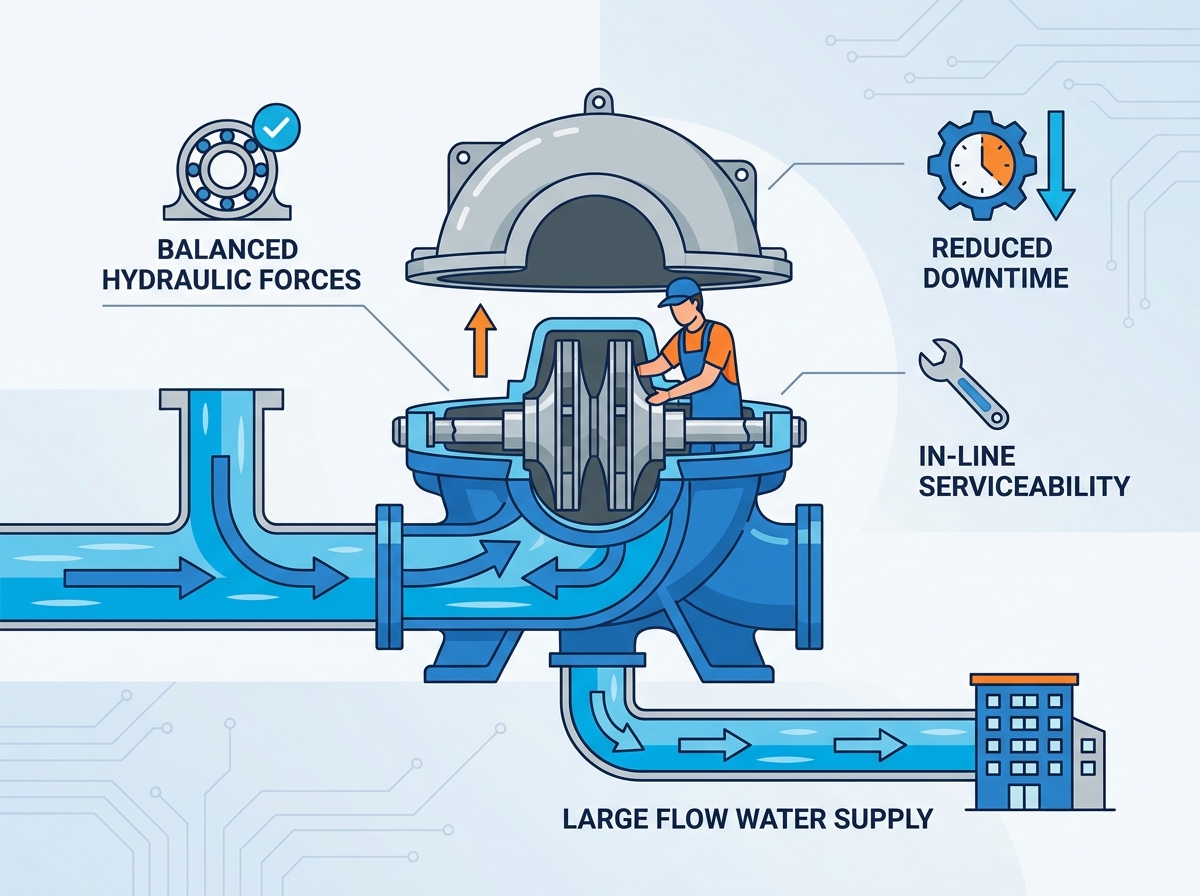
A double suction split case pump solves structural imbalances through brilliant internal fluid dynamics. The specialized impeller design draws water from both sides simultaneously. Fluid enters the main casing and splits evenly into two separate channels. It then feeds directly into opposite sides of the rotating impeller eye.
This dual flow path yields a tremendous mechanical outcome. It creates a natural neutralization of axial thrust. Because opposing hydraulic forces cancel each other out, the pump shaft experiences virtually zero lateral stress. This drastically reduces the mechanical stress placed on thrust bearings compared to single-suction designs. Bearings run cooler. Mechanical seals maintain perfect alignment and last significantly longer. The entire rotating assembly achieves exceptional longevity, often reaching an L10 bearing life exceeding 100,000 hours.
Cavitation ruins impellers and destroys system efficiency. The divided flow path inherently lowers the Net Positive Suction Head required (NPSHr). Because water enters two separate suction eyes instead of one, the fluid velocity drops by half. Lower fluid velocity means lower pressure drops at the impeller entry points.
This translates directly into massive operational value. You severely reduce the risk of cavitation occurring during peak demand spikes. The pump operates much quieter, eliminating the abrasive noise associated with cavitating pumps. Quiet operation is crucial in commercial environments like hospitals or office towers where acoustic comfort matters. Furthermore, a lower NPSHr gives facility managers greater flexibility when designing the mechanical room layout and determining cooling tower elevations.
Maintenance budgets often dictate equipment selection in modern commercial real estate. The split casing design provides an unmatched primary maintenance advantage. Technicians can unbolt and remove the top half of the casing to completely expose the rotating element. You can easily inspect or replace the impeller, shaft, bearings, and seals from above.
The defining benefit here involves piping system integrity. The lower pump casing remains firmly bolted to the heavy piping network. The electric motor remains securely fastened in place on the baseplate. You never need to disconnect heavy suction or discharge flanges. You completely avoid disturbing the carefully aligned pipe strain parameters. Rigging heavy motors out of the way becomes a thing of the past.
Accessibility translates directly to lower operational expenditure (OpEx). It also minimizes facility disruption during scheduled maintenance. Let us compare the labor requirements for overhauling different pump styles.
Downtime Comparison Chart: Split Case vs. End-Suction Pump
Maintenance Task | Standard End-Suction Pump | Split Case Architecture |
|---|---|---|
Accessing the Impeller | Requires heavy motor removal and piping disconnection | Simply unbolt and lift the top casing half |
Bearing and Seal Replacement | Complex blind disassembly, high labor hours | Fully exposed components, minimal labor hours |
Piping Strain Risks | High risk of flange misalignment upon reassembly | Zero risk; lower casing remains piped in |
Post-Service Realignment | Mandatory full laser alignment required | Minimal realignment needed if motor stays fixed |
Estimated Downtime (Full Overhaul) | 12 to 18 hours per unit | 4 to 6 hours per unit |
This dramatic reduction in labor hours directly lowers ongoing maintenance costs. Technicians work safer and faster. Facilities can return to full cooling or heating capacity in a fraction of the time, protecting sensitive building environments from severe temperature fluctuations.
Engineers must identify the exact capacity threshold where these pumps become the most efficient choice. Typically, applications demanding high gallons per minute (GPM) at moderate head pressures justify the upgrade. Once your system requirements exceed 1,000 to 1,500 GPM, split casing models easily outshine the competition in both efficiency and durability.
However, you must acknowledge spatial realities. These pumps require a larger horizontal footprint than vertical inline alternatives. They also demand a robust concrete housekeeping pad to support their extensive baseplates. You must allocate adequate floor space during the early schematic phases of mechanical room design. Retrofitting them into cramped existing basements often proves challenging.
Smart facility planning requires a long-term Lifecycle Cost (LCC) analysis. You must break down the complete financial picture over a 15 to 25-year lifespan. This calculation includes the initial purchase price, installation expenses, daily energy consumption, and scheduled maintenance intervals.
The initial capital expenditure (CapEx) for split casing equipment runs higher than standard pumps. Yet, high-efficiency operation easily offsets this upfront premium. These pumps frequently hit 85% to 90% efficiency at their Best Efficiency Point (BEP). Because energy consumption represents the largest lifetime expense for any fluid transport system, these steady power savings guarantee a superior return on investment. Pairing them with Variable Frequency Drives (VFDs) multiplies these energy savings even further during partial load conditions.
Deploying massive rotating equipment requires precise execution. Poor installation easily negates the inherent advantages of superior engineering. Watch out for these three critical rollout risks during the construction phase.
Precision Alignment Requirements: The pump and motor share a single fabricated steel baseplate. However, transit stress and installation procedures inevitably shift these components out of factory alignment. Laser alignment is absolutely critical during field installation. Technicians must dial in the shaft alignment to tight tolerances. Failing to do so causes premature coupling wear and rapid bearing failure.
Piping Design Considerations: Improper suction piping design destroys hydraulic balance. If you place elbows, strainers, or valves too close to the suction flange, severe turbulence occurs. This uneven flow disrupts the fluid entering the double suction impeller, completely negating its primary thrust-balancing advantage. Always follow established industry standards requiring five to ten pipe diameters of straight run before the suction inlet.
Weight and Rigidity: These units possess immense physical mass and generate considerable operational torque. A highly rigid foundation is necessary to absorb vibration. You must pour a proper concrete inertia base and correctly grout the baseplate. This solid mass ensures the equipment maintains its critical laser alignment over decades of continuous, heavy-duty use.
Choosing a heavy-duty pump requires looking far beyond the initial price tag. A split casing pump represents a serious long-term investment in facility uptime and mechanical stability. It is never meant to serve as a budget-level fix. By neutralizing destructive axial thrust and simplifying internal maintenance access, these units protect your critical infrastructure from unexpected failures.
Consider these action-oriented next steps for your upcoming mechanical project:
Conduct a comprehensive 20-year Lifecycle Cost (LCC) analysis comparing energy draws at your specific duty points.
Review your peak flow-rate parameters with a dedicated pump sizing specialist to verify strict BEP alignment.
Audit your mechanical room floor plans early to guarantee adequate space for concrete inertia bases and straight piping runs.
A: General thresholds typically start around 1,000 to 1,500 GPM. The exact transition point depends heavily on your specific head requirements and continuous duty cycle needs. Once flow demands cross this mark, the resulting energy savings and enhanced hydraulic stability easily outpace the higher initial capital costs.
A: No. Vertical Split Case (VSC) pumps exist specifically to provide the same exceptional maintenance advantages while drastically reducing the mechanical room footprint. They utilize the identical divided casing design but orient the shaft vertically to save highly valuable floor space in tight environments.
A: It optimizes hydraulic balance and operates at significantly higher efficiencies during large flow rates. By drawing water from both sides simultaneously, it reduces internal turbulence and fluid pressure drops. This refined efficiency reduces the required motor horsepower needed to achieve the exact same output.
A: Yes. It requires unobstructed, straight runs of pipe leading directly into the suction flange. You typically need 5 to 10 pipe diameters of straight piping. This ensures uniform, laminar flow distribution to both sides of the impeller, which actively prevents cavitation and mechanical imbalance.


